Leading Centrifuge Machine Manufacturer Supplier in China
You are here:Home » Blog » Centrifuge Capacity Planning: Large Capacity vs Parallel Units
Centrifuge Capacity Planning: Large Capacity vs Parallel Units
Views: 0 Author: Site Editor Publish Time: 2026-10-16 Origin: Site
Laboratory Throughput Planning
Capacity should be planned around the busiest workflow, not the largest rotor specification.
Centrifuge capacity is often compared by maximum millilitres per run. That number describes the rotor envelope, but it does not tell a laboratory how many real samples can be completed during the busiest part of the day.
A useful capacity plan starts with peak workload, actual vessels per run, full cycle time, protocol concurrency and acceptable downtime.
These variables determine whether one larger centrifuge, two parallel units, or a main centrifuge plus a dedicated secondary unit is the more efficient equipment architecture.
Capacity planning sequence: Peak workload → Vessels per run → Full cycle time → Parallel demand → Downtime tolerance
Maximum Rotor Capacity Is Not Laboratory Throughput
Maximum capacity, maximum speed and maximum RCF describe equipment capability. Throughput describes how many usable samples the laboratory can actually complete in a defined period. The two should not be treated as the same metric.
Input 01Actual vessels per run
×
Input 02Completed runs per hour
=
OutputEffective hourly throughput
Completed runs per hour must use the full operating cycle.
LoadBalanceAccelerateSpinDecelerateUnload
Plan for the Peak Window, Not the Daily Average
More useful metric Peak samples / hour
The period most likely to create a queue determines whether the installed centrifuge capacity is sufficient.
A laboratory processing 400 samples per day can have very different equipment needs depending on how those samples arrive.
If the workload is distributed evenly across an eight-hour day, a moderate-capacity platform may be sufficient. If 250 samples arrive within a two-hour morning window, the same daily volume creates a much higher peak processing requirement.
Capacity planning should therefore record daily volume, peak-window volume and maximum acceptable waiting time as separate values.
Use Actual Vessels per Run Instead of Nominal Millilitres
A rotor described as 1200 mL does not automatically tell a buyer how many real laboratory samples it can process. Tube, bottle, bucket and adapter combinations determine the usable batch size.
Clinical laboratories may need to know how many blood collection tubes can be processed in one run. Research laboratories may care about the number of 15 mL or 50 mL conical tubes. Cell-processing workflows may instead use bottles or larger vessels.
For capacity planning, the more useful value is: actual vessels per run using the intended rotor and adapter.
When One High-Capacity Centrifuge Makes More Sense
Single large platform
Strong fit for concentrated, uniform batches
Large numbers of samples arrive together.
The same vessel and protocol dominate the workflow.
The laboratory can wait for a full or near-full batch.
Reducing the number of runs is operationally valuable.
Large bottles or high-volume vessels are required.
Parallel units
Strong fit for continuous or mixed workflows
Samples arrive continuously throughout the day.
Different protocols need to run at the same time.
STAT or priority samples must bypass routine batches.
Temperature-controlled and ambient work overlap.
One equipment failure cannot stop the whole workflow.
Parallel Capacity Can Exceed a Larger Single Batch
Illustrative workflow calculation Hypothetical values only — replace with the actual rotor and full cycle time.
Option A · One larger centrifuge
Capacity24 tubes / run
Full cycle15 minutes
Runs / hour4
Throughput96 tubes / hour
One large batch reduces the number of individual runs.
Option B · Two parallel centrifuges
Capacity12 tubes / run each
Full cycle12 minutes
Combined runs / hour10
Combined throughput120 tubes / hour
Smaller batches can still provide higher hourly capacity when processing runs in parallel.
Capacity Problems Are Often Scheduling Problems
Conflict 01 Different RCF
Two protocols requiring different centrifugal force cannot occupy the same machine at the same time even if rotor capacity remains available.
Conflict 02 Different run time
A long protocol can block shorter workflows and create queues unrelated to nominal rotor capacity.
Conflict 03 Different temperature
Refrigerated and ambient workflows may create separate operating requirements during the same peak window.
Conflict 04 Priority samples
Routine batches can occupy a large centrifuge when an urgent or short-spin sample needs immediate access.
Three Equipment Architectures Cover Most Capacity Problems
01
One high-capacity centrifuge
Appropriate when sample type, protocol and arrival pattern are highly standardized and larger batches can be accumulated without delaying the workflow.
Best starting point Uniform, batch-oriented processing.
02
Two or more parallel centrifuges
Appropriate when continuous arrivals, multiple protocols or uptime requirements make simultaneous processing more valuable than the largest possible single batch.
Best starting point Mixed workflows and peak-hour queues.
03
Main centrifuge + dedicated secondary unit
Appropriate when one workflow represents most of the sample volume, while a smaller proportion requires special vessels, refrigeration, microtubes, plates or rapid priority access.
Best starting point High-volume routine work plus specialist workflows.
GlanLab Platforms Cover Different Capacity Architectures
The useful comparison is not simply small versus large. Different GlanLab platforms support different combinations of batch size, rotor flexibility, temperature control and installation requirement.
Flexible Medium Capacity
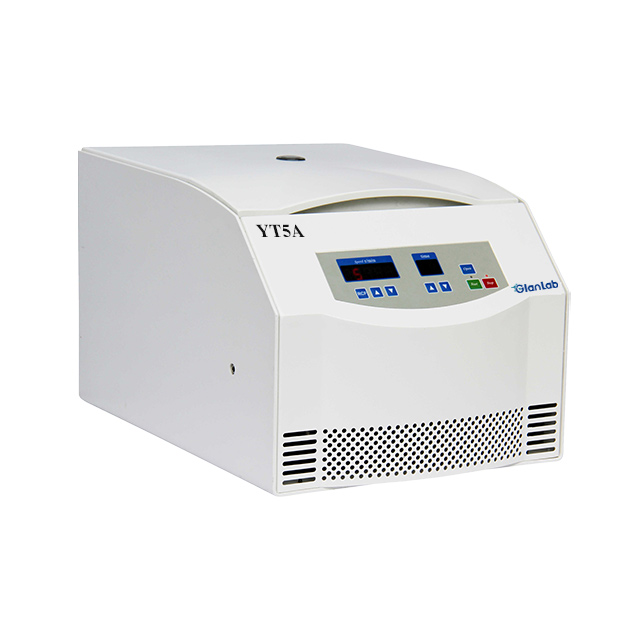
YT5A / YT5AR
5,000 rpm4,730 ×gUp to 4 × 300 mL
A useful reference for laboratories needing a flexible medium-capacity platform. YT5AR adds refrigerated operation where temperature-controlled workflows are required.
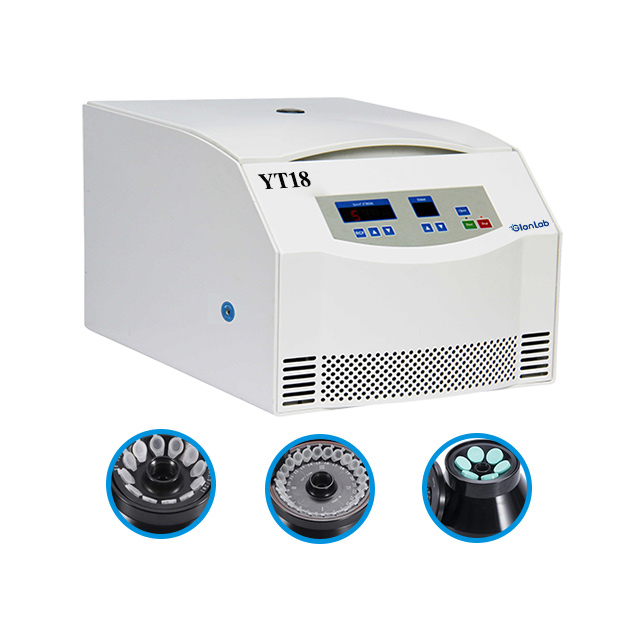
A broad rotor platform covering microtube, PCR, larger tube, microplate and higher-capacity configurations. It is relevant where several workflows need to share one centrifuge platform.
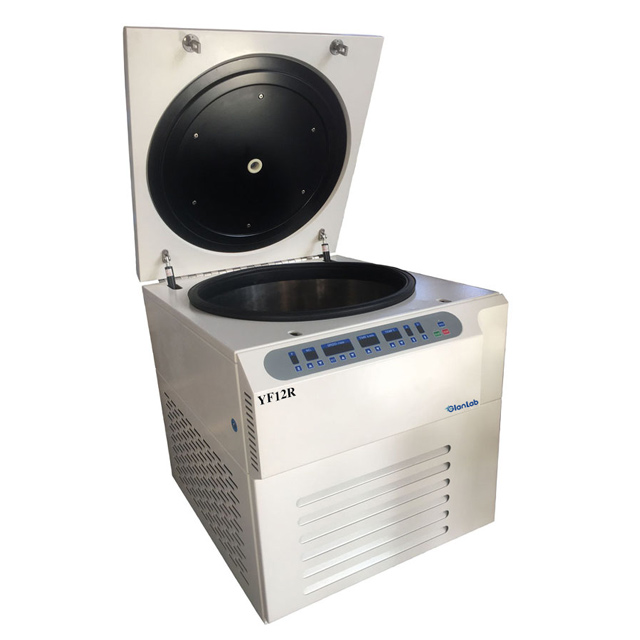
For workflows beyond the 4 × 1000 mL class, GlanLab also provides larger-capacity floor-standing centrifuge options. These projects should include installation space, electrical supply, transport and unloading requirements in addition to sample throughput.
Send the Peak Workflow, Not Only the Required Capacity
Provide the sample vessel, daily and peak sample volume, required RCF, full cycle time, temperature requirements, simultaneous protocols, available space and acceptable downtime. GlanLab can then compare large-capacity, parallel and mixed-platform configurations.
GlanLab, with over 20 years of experience, manufactures a full range of centrifuge machines, including benchtop, high-speed, floor-standing, and specialized models in China. We offer distribution, wholesale, OEM services, and single-unit orders at competitive prices. With complete quality certifications and robust after-sales support, GlanLab is your trusted partner for centrifuge supplies.