When it comes to cell biology research, precision and reliability are paramount. A cell culture centrifuge is a fundamental tool that supports critical processes such as separating cells from culture media, isolating subcellular components, and preparing samples for further analysis. The accuracy of these processes heavily relies on choosing the right centrifuge. In this guide, we will walk you through the key considerations for selecting the ideal centrifuge for cell culture applications, helping you understand the critical factors involved in ensuring optimal results. By selecting the correct cell culture centrifuge, you will not only enhance the quality of your experiments but also improve the efficiency of your lab processes.
Why Choosing the Right Cell Culture Centrifuge Matters
A cell culture centrifuge is a vital piece of equipment in a biological lab. Centrifuges are designed to separate various components in a sample by using centrifugal force, which results in the settling of denser particles such as cells to the bottom of the tube. The correct centrifuge ensures that your experiment runs smoothly, produces accurate results, and preserves the integrity of your samples.
Sample Sedimentation and Supernatant Separation: One of the most critical tasks a centrifuge handles is the separation of cells from culture media. Using the right centrifuge ensures that cells are efficiently separated while leaving behind a clear supernatant for further analysis.
Potential Risks of Choosing the Wrong Centrifuge: A poorly chosen centrifuge could lead to sample degradation, contamination, or even the need to repeat experiments, which wastes time and resources. Selecting the wrong speed, force, or tube compatibility could impact cell viability and lead to incorrect results. For instance, high speeds might damage sensitive cells, while insufficient force might not separate components effectively.
In conclusion, using the right cell culture centrifuge minimizes these risks, enhancing the overall efficiency of the lab and ensuring reliable results.
Understanding Centrifugation Basics for Cell Biology
To appreciate the importance of selecting the right cell culture centrifuge, it’s crucial to understand the fundamental principles of centrifugation. The process involves spinning samples at high speeds to create a centrifugal force that separates particles of different densities. The denser components move toward the bottom of the tube, forming a pellet, while the lighter components remain in the supernatant.
RPM vs RCF (Relative Centrifugal Force): Although RPM (revolutions per minute) is commonly used to measure centrifuge speed, RCF is the actual force applied to the sample and is a much more accurate indicator of the separation effectiveness. RCF is critical when working with sensitive samples like cell cultures, as it determines how effectively cells will settle and how other components will be separated.
What Is RCF and Why It Counts for Cell Cultures
RCF is a better measure of the force acting on your sample during centrifugation, as it takes into account the radius of the rotor and speed. It directly affects the efficiency of cell sedimentation and supernatant separation. An accurate understanding of RCF ensures the right settings for a centrifuge, preventing cell damage and ensuring proper sample preparation.
Sample Volume and Tube Type in Cell Workflows
Choosing the appropriate tube and centrifuge combination is crucial to ensure efficiency in your cell culture workflows. Large volume tubes (15–50 mL) are commonly used for larger samples, while microcentrifuge tubes (1.5–2 mL) are used for smaller volumes, such as DNA/RNA isolation or protein precipitation. If the wrong tube type is used, samples might not settle as expected, or some might be lost during processing.
Types of Cell Culture Centrifuges Labs Should Consider
Selecting the right cell culture centrifuge depends on the nature of your experiments and the sample volumes you typically work with. There are various types of centrifuges available, each designed to handle specific cell culture tasks.
Centrifuge Type | Use Case | Advantages |
Benchtop Centrifuges | Ideal for routine cell collection, supernatant separation | Compact, easy to use, and suitable for small sample sizes |
High-Speed Centrifuges | Necessary for fine separation of cell populations or fragments | High RCF for precision separation of delicate components |
Refrigerated Centrifuges | Used for temperature-sensitive cell cultures | Maintains constant temperature to protect cells during processing |
Key Factors to Evaluate Before Selecting a Cell Culture Centrifuge
Before selecting a cell culture centrifuge, it’s important to assess the specific needs of your lab. Each experiment may have different requirements, such as sample volume, speed, temperature control, and rotor compatibility.
Factor | Importance | Considerations |
Application Scope | Determines the centrifuge’s versatility | Understand the type of experiments being conducted, such as cell harvesting or protein separation |
Capacity & Rotor Compatibility | Ensures the centrifuge fits your lab's sample volume requirements | Make sure the centrifuge can handle the sample volumes you need for your cell culture experiments |
Temperature Control | Necessary for temperature-sensitive cells | Choose refrigerated centrifuges if temperature stability is critical for your samples |
Speed & Force Needs | Directly impacts the efficiency of separation | Match the centrifuge's speed (RPM) and force (RCF) to the needs of your sample and experiment |
Safety & Maintenance | Ensures safe and long-term operation | Look for features such as automatic lid locks, imbalance detection, and easy-to-clean components |
Selecting the right centrifuge for your specific research needs ensures that you will achieve the highest possible accuracy and reproducibility in your experiments.
Common Mistakes When Choosing a Cell Culture Centrifuge
When it comes to choosing a cell culture centrifuge, many labs make common mistakes that lead to poor results and wasted resources.
Focusing Only on RPM: Many labs mistakenly focus on RPM when choosing a centrifuge. However, RCF is the key factor that determines how effective the separation will be. Always ensure the centrifuge’s RCF is sufficient for your experiments.
Overlooking Sample Volume and Throughput Needs: Some labs fail to consider the sample volume requirements. Selecting a centrifuge with insufficient capacity or throughput capability can result in inefficiency, requiring the use of multiple cycles.
Neglecting Temperature Control: Temperature-sensitive cells require careful temperature control during centrifugation. Opting for a non-refrigerated centrifuge may result in the degradation of sensitive cell cultures.
By understanding these common mistakes, labs can avoid costly errors and improve the efficiency of their experiments.
How GLANLAB Cell Culture Centrifuges Support Your Lab Needs
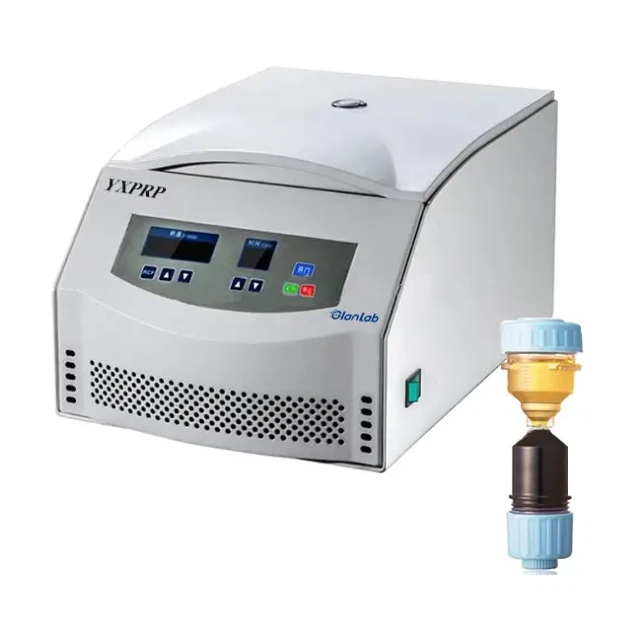
At GLANLAB, we understand that the right cell culture centrifuge can make all the difference in your research. Our YX-PRP series centrifuges are designed with precise control over speed, temperature, and rotor options, making them perfect for cell sedimentation, fragmentation separation, and culture medium processing. With GLANLAB’s advanced centrifuge technology, you can trust that your experiments will run smoothly, providing reliable and reproducible results.
Key Features of GLANLAB Centrifuges
Advanced Safety Features: Our centrifuges come equipped with automatic lid locks and imbalance detection to ensure safe operation at all times.
Precision Control: Achieve consistent results with programmable settings tailored to meet the needs of your experiments.
Cost-Effective & Reliable: GLANLAB offers centrifuges that provide excellent value without compromising on performance. Our products are trusted by labs around the world.
Conclusion
In conclusion, selecting the best cell culture centrifuge is a critical decision that affects the accuracy and reliability of your lab's experiments. Whether you are isolating cells, separating culture media, or concentrating proteins, the right centrifuge ensures that your results are precise and reproducible. By considering factors such as sample volume, speed, temperature control, and rotor compatibility, you can make an informed choice that supports long-term success in your lab.
For more information on GLANLAB’s cell culture centrifuges, or to inquire about our products, please contact us today.
FAQs
Q1: What is the difference between RPM and RCF in centrifugation?
RPM refers to the rotational speed of the centrifuge, while RCF is the relative centrifugal force. RCF is a more accurate measure of the force acting on the sample.
Q2: Can GLANLAB centrifuges handle temperature-sensitive samples?
Yes, GLANLAB offers refrigerated centrifuges that maintain precise temperature control to protect temperature-sensitive cells.
Q3: How do I know which centrifuge is right for my lab?
Consider your sample volumes, required speed (RPM/RCF), and whether temperature control is necessary. GLANLAB offers a variety of centrifuges to meet different lab needs.
Q4: What safety features do GLANLAB centrifuges include?
Our centrifuges are equipped with automatic lid locks, imbalance detection, and other safety features to ensure safe operation at all times.


