Centrifugation is a fundamental technique used in laboratories to separate components of a mixture based on their density. To effectively control and optimize this process, understanding three critical terms—RCF (Relative Centrifugal Force), RPM (Revolutions Per Minute), and G-Force (G-force)—is essential. These terms are crucial in determining the efficiency of centrifugation, and each plays a unique role in ensuring the right conditions for sample separation.
I What Are RCF, RPM, and G-Force?
At GlanLab, we specialize in providing high-quality centrifuge products that offer precision and efficiency for a wide range of laboratory applications. Our centrifuges are designed with RCF and RPM considerations in mind, ensuring optimal separation results for all your laboratory needs.
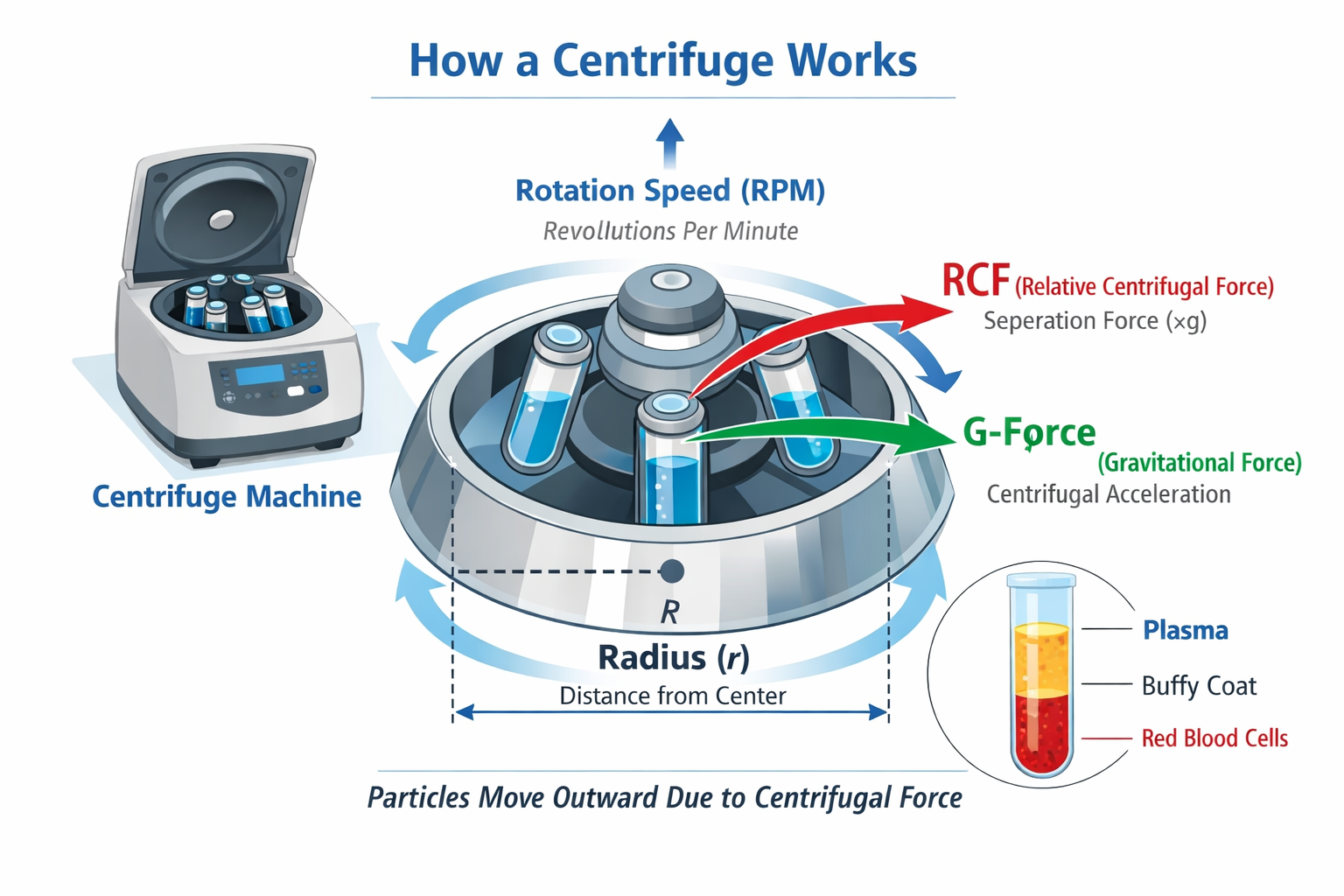
RCF (Relative Centrifugal Force) is the actual force exerted on a sample during centrifugation, measured in multiples of the Earth's gravitational force (×g). This value is important as it directly correlates with the separation efficiency.
RPM (Revolutions Per Minute) refers to the speed at which the centrifuge rotor spins. RPM gives an idea of the mechanical speed, but does not account for the radius of the rotor.
G Force (also called gravitational force) is often used interchangeably with RCF but specifically refers to the centrifugal force applied during the spin, measured in g’s.
In this guide, we will break down the differences between these terms, how they work together in a centrifuge, and their practical applications.
I How Centrifuges Work — Basic Principles
At its core, centrifugation is a process that uses high-speed spinning to apply centrifugal force, which separates particles based on their size and density. The particles experience varying accelerations depending on their distance from the center of the centrifuge rotor.
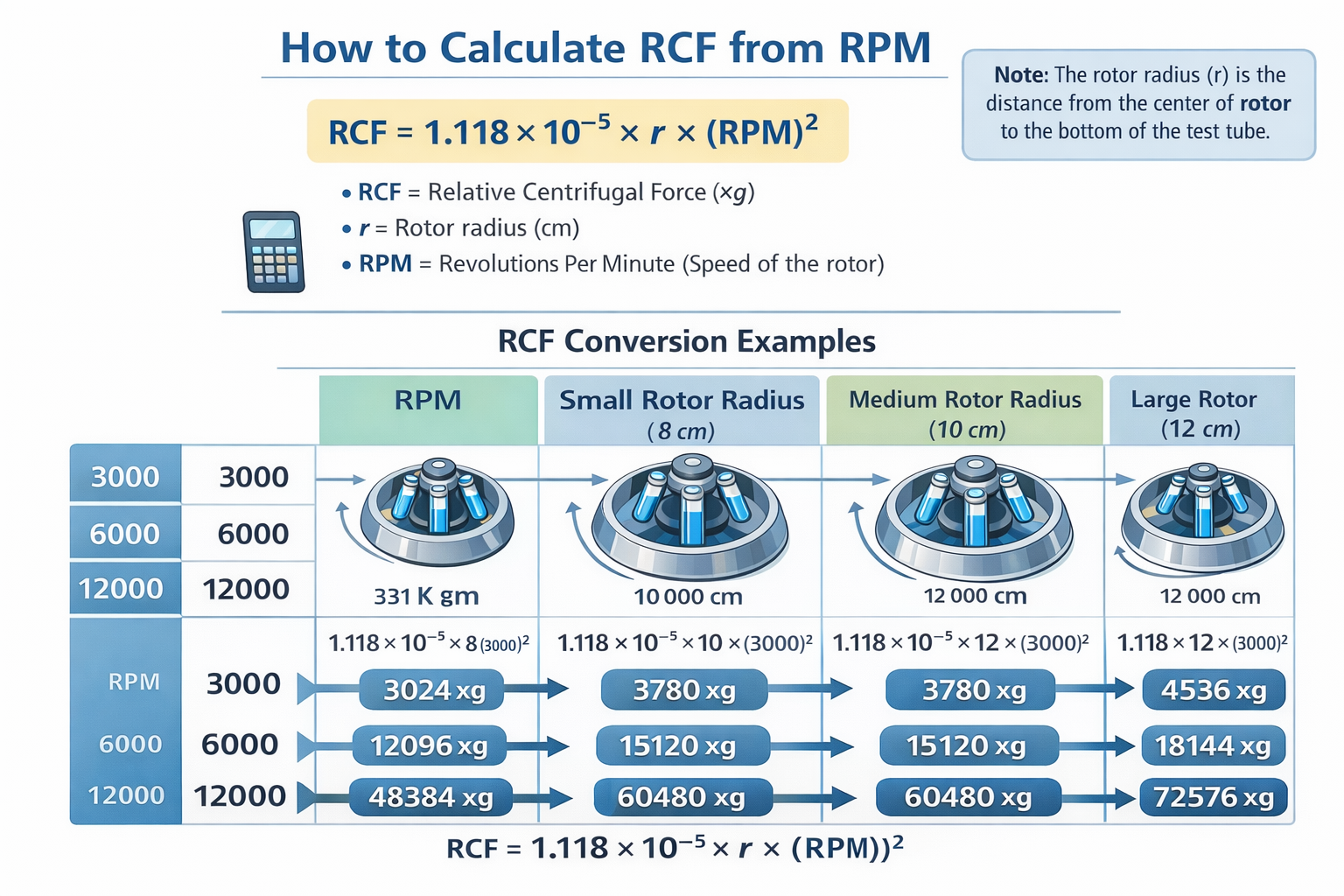
The rate at which a sample spins (RPM) and the radius of the rotor combine to determine the actual force experienced by the sample (RCF). The formula used to convert RPM to RCF is:
RCF = 1.118 × 10⁻⁵ × r × (RPM)⊃2;,
Where r is the radius (in cm) of the centrifuge rotor, and RPM is the speed of rotation. This calculation is critical in setting the correct operational parameters for effective separation.
I RCF vs. RPM vs. G-Force: What’s the Difference?
While RPM, RCF, and G-Force are all essential aspects of centrifugation, they are not interchangeable. Understanding how they differ will help in choosing the right parameters for different laboratory applications.
Table: Key Differences at a Glance
Parameter | Definition | Unit | Advantage | Consideration |
RPM | Revolutions per minute | rpm | Provides a direct measure of the speed of the rotor | Does not account for the rotor radius |
RCF | Relative centrifugal force | ×g | More accurate for sample separation efficiency | Requires rotor radius for calculation |
G-Force | Centrifugal acceleration | ×g | Directly correlates with the force acting on particles | Often used interchangeably with RCF |
As shown in the table, RPM measures the rotor’s rotational speed, but it does not directly indicate the actual force exerted on a sample. The RCF, on the other hand, provides a more reliable measure of the force that will separate the components of a mixture. While G Force is often used as a synonym for RCF, the two terms are essentially the same, both representing the centrifugal force applied during centrifugation.
I The Science Behind Conversion: How to Convert RPM to RCF
Centrifuge users often need to convert RPM to RCF to optimize their separation processes. The conversion is especially important because different centrifuges use different rotor sizes, which affect the actual centrifugal force at a given RPM.
To convert RPM to RCF, the formula is:
RCF = 1.118 × 10⁻⁵ × r × (RPM)⊃2;
Where r is the radius in centimeters and RPM is the speed of the rotor in revolutions per minute.
Example Calculation:
If a centrifuge rotor has a radius of 10 cm and operates at 3000 RPM, the RCF would be:
RCF = 1.118 × 10⁻⁵ × 10 × (3000)⊃2; = 1000 × g
This means the sample in the centrifuge would experience a force 1000 times that of gravity.
I Why Use RCF Instead of RPM in Lab Protocols?
In laboratory settings, RCF is preferred over RPM for several reasons:
RCF is independent of rotor size, making it a more universally applicable unit. Whether you're using a small benchtop centrifuge or a large industrial model, RCF allows for more consistent results across different equipment.
Accuracy in separation: RCF directly correlates with the force exerted on the sample, allowing scientists to more effectively tailor their centrifugation conditions to their experimental needs.
Standardization: Many scientific journals and protocols use RCF to standardize centrifugation conditions, ensuring reproducibility and comparability of results.
By focusing on RCF, you can ensure more precise control over your sample’s separation process, avoiding the inconsistencies that might arise from using RPM alone.
I Practical Examples: Setting the Right Parameters
Example 1: Blood Separation
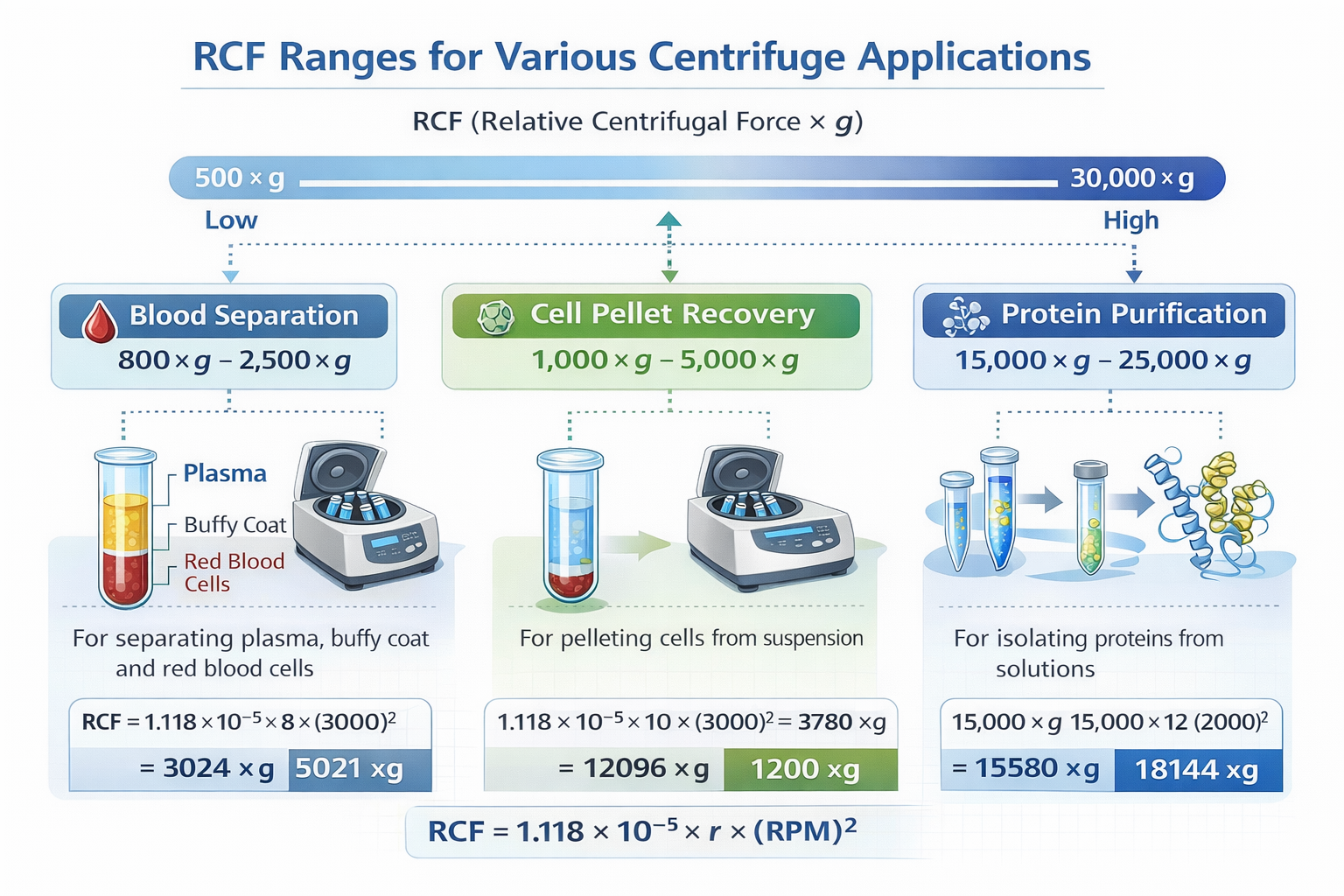
In blood separation protocols, centrifuges typically operate at RCF values between 800–2500 ×g. Higher RCF values are used for separating blood components like plasma and red blood cells. For a standard blood separation protocol, an RCF of 1500 ×g at 3500 RPM (for a rotor radius of 10 cm) may be used.
Example 2: Cell Pellet Recovery
For cell pellet recovery, an RCF range of 3000–5000 ×g is typically used. A higher RCF ensures efficient cell sedimentation, which is crucial when working with small cells or low-concentration samples.
I Choosing the Right Centrifuge: GLANLAB Centrifuge Types
When selecting a centrifuge for your laboratory, it’s important to consider the RCF and RPM ranges of the device to match your specific applications. GlanLab offers a wide variety of centrifuges to meet the needs of different laboratory environments.
High-Speed Centrifuges: For applications requiring high RCF values, such as protein purification or viral particle separation.
Low-Speed Centrifuges: Ideal for blood separation and other low-speed applications.
Each centrifuge model from GlanLab is designed to provide precise control over RCF and RPM, making it easier to achieve consistent and reliable results.
I Tips for Optimizing Centrifugation Outcomes
To achieve optimal results, here are some tips for adjusting RCF and RPM settings:
Always calculate the required RCF based on your sample type, rotor radius, and the nature of the separation.
Use lower RPM settings for delicate samples to avoid damage while maintaining an appropriate RCF.
Ensure that the centrifuge is balanced before starting to prevent uneven forces that could lead to inaccurate results.
Conclusion
In summary, understanding the relationship between RCF, RPM, and G Force is essential for optimizing centrifugation processes. At GlanLab, we offer centrifuge products designed with precision and flexibility, making it easy for researchers to achieve the best results across a variety of applications. Whether you are separating blood components or purifying proteins, GlanLab's centrifuges provide the reliability and control you need to excel in your work.
Call to Action: Explore our range of high-performance centrifuges at GlanLab to find the perfect model for your laboratory’s needs!
FAQ
Q: What’s the difference between RCF and RPM?
A: RCF refers to the actual force experienced by the sample, while RPM indicates the speed of the rotor. RCF is a more accurate measure of the separation efficiency.
Q: Why do I need to use RCF in my protocol?
A: RCF is more consistent and universally applicable across different centrifuges, ensuring reproducibility and accurate sample separation.
Q: How do I convert RPM to RCF?
A: Use the formula RCF = 1.118 × 10⁻⁵ × r × (RPM)⊃2; to calculate RCF based on your centrifuge’s rotor radius and RPM.


