A centrifuge is a vital piece of laboratory equipment used in various scientific and industrial processes. It operates by using centrifugal force to separate different components in a mixture. Through rapid spinning, denser substances are pushed to the outer edges, while lighter substances stay closer to the center. This process plays a crucial role in industries such as medical testing, biotechnology, chemical processing, and even food production. In this article, we will dive into what a centrifuge is, how it works, the different types, and its many applications across various sectors.
I What Is a Centrifuge?
A centrifuge is a machine that separates materials by spinning them at high speeds. The force exerted during the spinning process (centrifugal force) pushes denser particles outward, while lighter particles remain at the center. The device is essential in numerous scientific, medical, and industrial applications, ranging from separating blood components in a clinical setting to purifying proteins in a laboratory.
The centrifuge works on the principle of density separation, where components in a mixture with different densities are separated based on the centrifugal force generated by the rotor’s motion. This separation is crucial for analyzing various components in liquids, gases, and even solids.
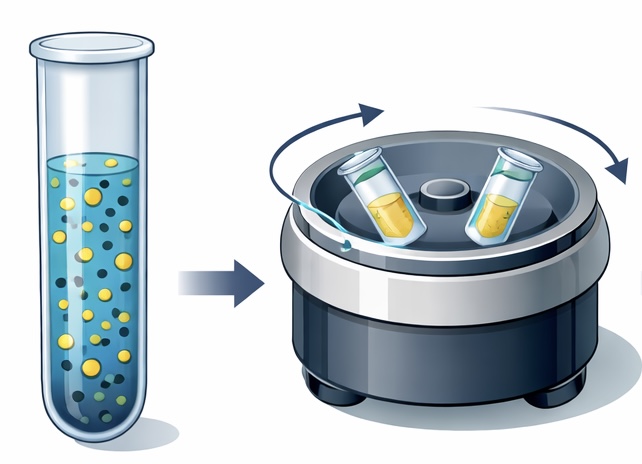
Sample & Spinning
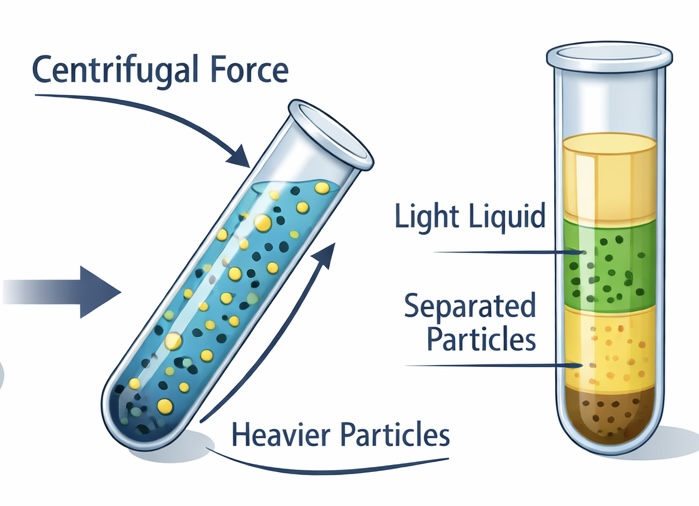
Centrifuge Force & Separation
I How Does a Centrifuge Work?
The core principle behind a centrifuge is the centrifugal force that is generated by the rotor as it spins. This force pushes heavier, denser components to the bottom of the sample tube, while lighter components float toward the top. The speed at which the rotor spins (measured in RPM) and the force exerted by the machine (RCF or Relative Centrifugal Force) both play critical roles in determining the efficiency of separation.
RPM vs. RCF
RPM (Revolutions per minute) refers to how fast the rotor spins.
RCF (Relative Centrifugal Force) is the force applied on the sample during centrifugation, which is determined by both the rotor speed (RPM) and the radius of the rotor.
Key Factors for Effective Separation
Several factors contribute to the efficiency of centrifugation:
Speed (RPM): Higher speeds lead to stronger centrifugal forces, allowing for more precise separation.
Sample Density: Components with greater density will be pushed outward faster than those with lighter density.
Temperature: Some centrifuges offer refrigeration to protect temperature-sensitive samples, such as proteins or blood components.
Rotor Type: Different rotor designs, such as fixed-angle rotors and swing-bucket rotors, affect the direction and quality of the separation.
I Types of Centrifuges
Centrifuges come in many types, each designed for specific uses. They can be categorized based on speed, capacity, and the type of application.
1. By Speed / Performance
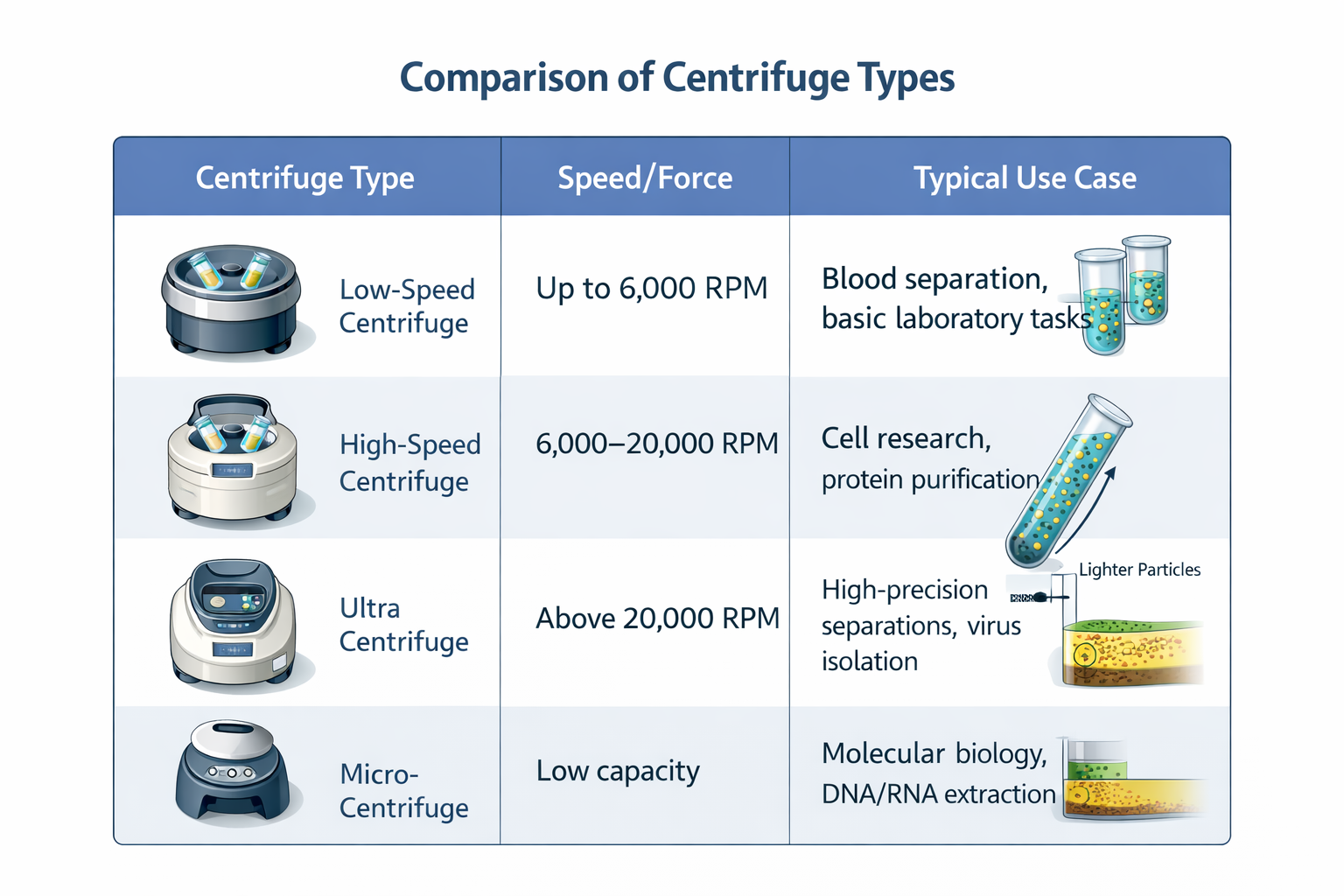
Low-Speed Centrifuges: These centrifuges generally operate at speeds up to 6,000 RPM and are commonly used for blood separation or basic laboratory applications.
High-Speed Centrifuges: With speeds ranging from 6,000 RPM to 20,000 RPM, these are suitable for more specialized applications, such as isolating cells or organelles.
Ultra Centrifuges: These powerful machines operate at speeds exceeding 20,000 RPM and are used for high-precision tasks, such as purifying viruses or sub-cellular components.
2. By Function / Application
Benchtop Centrifuges: These small units are ideal for laboratory tasks where space is limited and for daily use in research and diagnostic labs.
Clinical Centrifuges: Designed specifically for medical applications, these centrifuges are used to separate blood plasma, serum, and other bodily fluids.
Industrial Centrifuges: These high-capacity centrifuges are used in industries such as oil extraction, dairy production, and wastewater treatment.
Microcentrifuges: These are compact, high-speed centrifuges that are often used for molecular biology applications such as DNA and RNA extraction.
Comparison Table: Centrifuge Types
Centrifuge Type | Speed/Force | Typical Use Case |
Low-Speed Centrifuge | Up to 6,000 RPM | Blood separation, basic tasks |
High-Speed Centrifuge | 6,000–20,000 RPM | Cell research, protein purification |
Ultra Centrifuge | Above 20,000 RPM | High-precision separations, virus isolation |
Microcentrifuge | Low capacity | Molecular biology, DNA/RNA extraction |
I Applications of Centrifuges
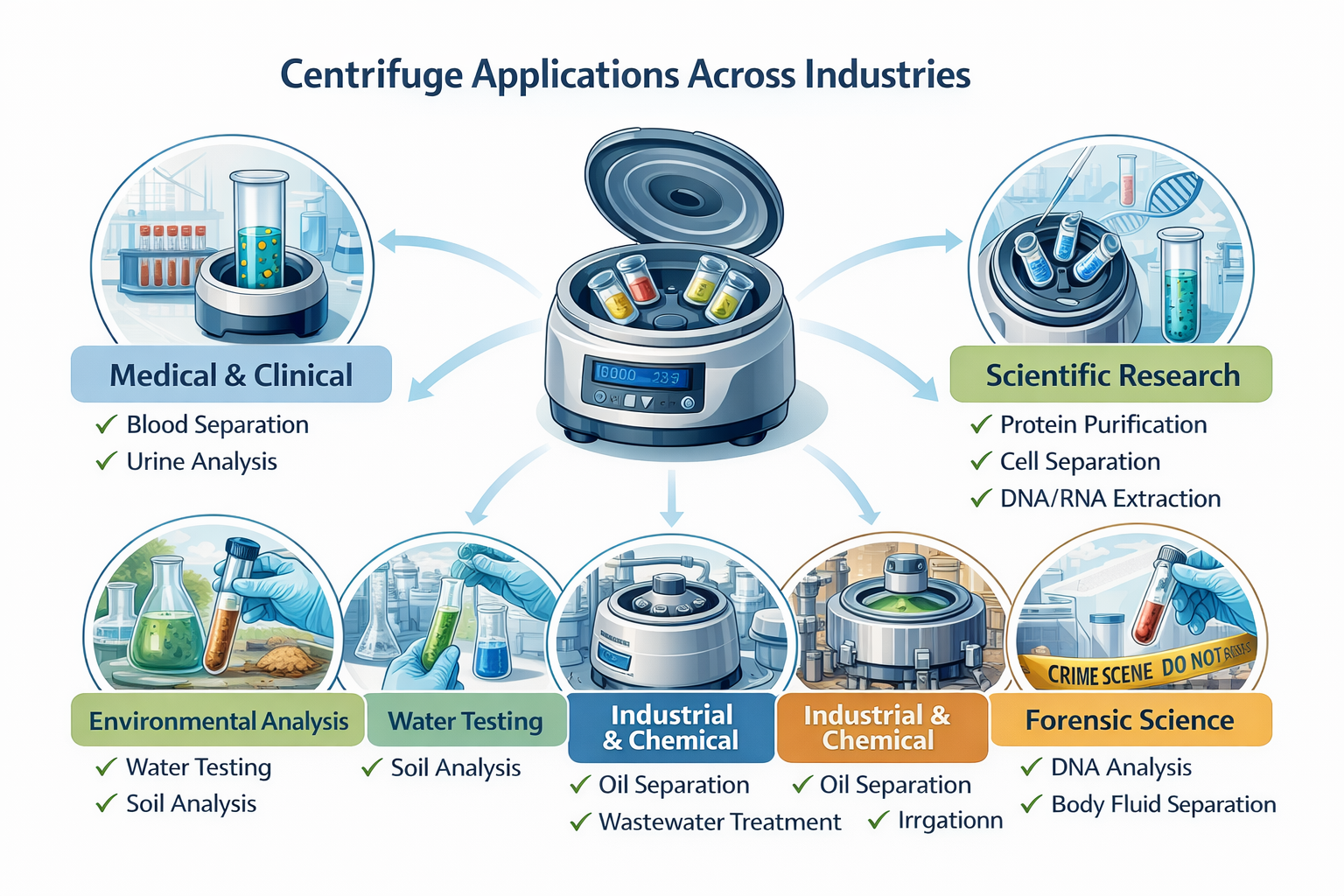
Centrifuges are indispensable tools in many industries and fields, including medicine, research, and manufacturing. Let's explore some of the key applications:
1. Medical & Clinical Applications
Blood Separation: Centrifuges are routinely used in hospitals and clinics to separate blood components like plasma, serum, and red blood cells.
Urine Analysis: Clinical centrifuges are also used for separating cells and crystals from urine samples.
Microbiological Testing: Centrifuges are essential for isolating microorganisms, such as bacteria and viruses, for diagnostic purposes.
2. Scientific Research & Life Sciences
Protein Purification: Centrifuges are widely used in biotechnology for isolating proteins and other macromolecules.
Cell Separation: They are employed to isolate different types of cells for experimentation in biological and medical research.
DNA/RNA Extraction: Molecular biology heavily relies on centrifuges to separate nucleic acids from biological samples.
3. Industrial & Chemical Applications
Oil Extraction: Centrifuges are used in the petroleum industry to separate crude oil from other substances such as water or sludge.
Food Industry: In the dairy industry, centrifuges separate cream from milk, while in the fruit juice industry, they clarify the juice.
Wastewater Treatment: Centrifuges help separate solids from liquids in water treatment processes.
4. Other Use Cases
Environmental Applications: Centrifuges are used to analyze soil samples, separating minerals and pollutants.
Forensic Science: Used to isolate and examine biological fluids at crime scenes.
I How to Choose the Right Centrifuge
Selecting the appropriate centrifuge depends on several factors:
Sample Type: Delicate biological samples may require a refrigerated centrifuge to avoid damage.
Required Speed: Higher speeds are needed for fine separation, while basic tasks can be done with low-speed models.
Volume: If you need to process a large number of samples, consider a floor-standing centrifuge with a higher capacity.
Maintenance and Features: Ensure that the centrifuge is easy to maintain and calibrate regularly.
Conclusion
Centrifuges are indispensable instruments that play an essential role in separating components in various mixtures. Whether you're working in a medical, scientific, or industrial setting, understanding how centrifuges work and selecting the right model for your needs will help optimize your processes. With the right centrifuge, you can achieve more precise and efficient separation, ensuring that your samples are properly processed and analyzed.
At GlanLab, we offer a range of centrifuge models to suit various applications. For more information or to discuss which centrifuge is right for your lab, contact us today.
FAQ
Q1: How do I know which centrifuge speed to use for my samples?
The appropriate speed depends on the density and size of the particles you're trying to separate. For example, blood separation typically requires low-speed centrifuges, while protein purification may require high-speed or ultra-centrifuges.
Q2: Can I use a centrifuge for DNA or RNA extraction?
Yes, microcentrifuges are often used in molecular biology for the extraction of DNA and RNA. The high speed and small capacity allow for efficient separation of nucleic acids.
Q3: How often should I maintain my centrifuge?
Regular maintenance is essential to ensure accurate and safe operation. You should clean the rotor and check for wear and tear regularly. Calibration should be performed annually, or more frequently if needed.
Q4: Are refrigerated centrifuges necessary?
Refrigerated centrifuges are crucial when working with temperature-sensitive samples such as proteins or cells that can degrade under heat. If your samples are sensitive to temperature, investing in a refrigerated model is highly recommended.


