Centrifuges are essential tools in scientific laboratories, utilized across a wide range of applications from molecular biology to clinical diagnostics. For laboratory professionals, understanding the centrifuge RCF (relative centrifugal force) and RPM (revolutions per minute) is critical to achieving accurate and reproducible results. However, despite their importance, many still struggle with the difference between RPM and RCF and how to properly calculate the forces in their centrifuge operations. This article will clarify the difference, provide insight into why RCF is more significant than RPM, and offer guidance on how to convert between these two values to optimize centrifuge performance.
What Are RPM and RCF and Why They Matter
Defining RPM and RCF
RPM, or revolutions per minute, refers to the speed at which the rotor spins inside a centrifuge. It indicates how fast the rotor turns but does not directly represent the force being applied to the sample. This makes RPM an important but incomplete measure for assessing centrifuge efficiency.
On the other hand, RCF stands for relative centrifugal force, which is a measure of the acceleration exerted on a sample during centrifugation. It is often expressed in terms of g, the acceleration due to gravity. Unlike RPM, which is a fixed rotational speed, RCF more accurately represents the force experienced by the sample at the bottom of the rotor tubes. This is because RCF depends on both the rotor speed and the radius of the rotor, making it a more relevant value for separation efficiency.
Why RCF is More Important Than RPM
While RPM tells you the speed of the centrifuge, it does not directly correlate to the force that impacts the sample, which is what ultimately determines the effectiveness of the separation. For example, two centrifuges could operate at the same RPM but with different rotor radii, resulting in different RCF values. A higher RCF is more likely to achieve faster and more complete separation, which is especially important when working with delicate biological samples like cells or proteins.
In practice, laboratory operators often use RCF as the primary value when setting up centrifuge runs to ensure proper sample processing. Thus, understanding RCF and its relationship to RPM is critical to achieving the desired results in the shortest amount of time.
How to Convert RPM and RCF
For laboratories that operate with various centrifuges or use multiple rotors, it’s crucial to know how to convert RPM to RCF and vice versa. The calculation is straightforward once you understand the formula.
Conversion Formula
The formula for converting RPM to RCF is:

Where:
RCF is the relative centrifugal force (in terms of gravity, g),
r is the radius of the rotor in centimeters (cm),
RPM is the revolutions per minute.
To find the RPM based on a desired RCF value, the formula is:
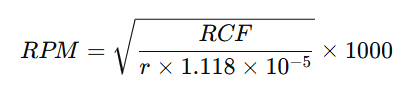
These formulas are essential for ensuring that you are applying the correct g-force when operating your centrifuge. It is important to know the rotor radius, denoted as rrr, because it directly influences the resulting centrifugal force. The unit for rotor radius is typically in centimeters or millimeters, so it's important to maintain consistent units for accurate results.
Why Rotor Radius Matters
The rotor radius rrr plays a crucial role in determining the RCF. A larger rotor radius generates a higher centrifugal force at the same RPM, meaning that different rotors require different RPM settings to achieve the same g-force. Therefore, when working with multiple rotor types, it's vital to adjust your RPM setting according to the rotor's radius to ensure consistent and accurate sample preparation.
Online Calculator Benefits vs Manual Calculation
When to Use an Online RCF ⇄ RPM Calculator
While manual calculation using the formulas provided above is effective, it can be tedious and prone to human error, especially when dealing with multiple rotor types and RPM settings. This is where an online RCF ⇄ RPM calculator comes in handy.
Online calculators can instantly provide accurate conversions between RPM and RCF, saving you time and reducing the risk of calculation errors. They are especially useful in busy laboratory settings, where time is often of the essence, and precision is critical. By using GlanLab’s RCF ⇄ RPM calculator, you can easily input your RPM or RCF values along with the rotor radius and get the corresponding result in just a few clicks.
How Manual Calculation Helps Verify Results
Though calculators offer convenience, performing manual calculations periodically ensures that the settings are correct and verifies the calculator’s output. By manually calculating the RCF based on your centrifuge’s RPM and rotor radius, you can ensure that the centrifugal forces applied to your samples meet the required standards. This verification is crucial when optimizing centrifugation parameters for highly sensitive experiments, particularly those involving biological specimens like cells, viruses, or enzymes.
To further facilitate the process, GlanLab provides both an online calculator and manual calculation guidelines to ensure you can choose the method that works best for your laboratory needs.
Example Calculation Scenarios
To illustrate the process, let's look at two practical examples of RCF and RPM conversion:
Example A: Given RPM + Rotor Radius → Finding RCF
Suppose you are using a rotor with a radius of 5.0 cm and the centrifuge operates at 3000 RPM. To calculate the resulting RCF, you can use the formula:

Thus, at 3000 RPM with a rotor radius of 5.0 cm, the resulting RCF is 5025 g.
Example B: Given Desired RCF → Finding Required RPM
If you require an RCF of 27895 g and are using a rotor with a radius of 10.0 cm, you can calculate the required RPM as follows:

In this case, the centrifuge should operate at 5000 RPM to achieve the desired RCF of 27895 g with a rotor radius of 10.0 cm.
RCF ⇄ RPM Examples Table
Rotor Radius (cm) | RPM | RCF (x g) |
5.0 | 3000 | 5025 |
10.0 | 5000 | 27895 |
These examples demonstrate the importance of accurate calculations and why understanding the relationship between RPM and RCF is critical for proper centrifugation.
Practical Tips When Setting Up a Run
Why Labs Prefer RCF Settings vs RPM Settings
In many laboratories, it's common practice to use RCF settings rather than RPM settings because RCF directly relates to the g-force experienced by the sample, which is more relevant for effective separation. RCF settings ensure that the force applied is optimal for the sample type and the desired outcome, regardless of rotor size.
How Modern Machines Allow Direct g-Force Input
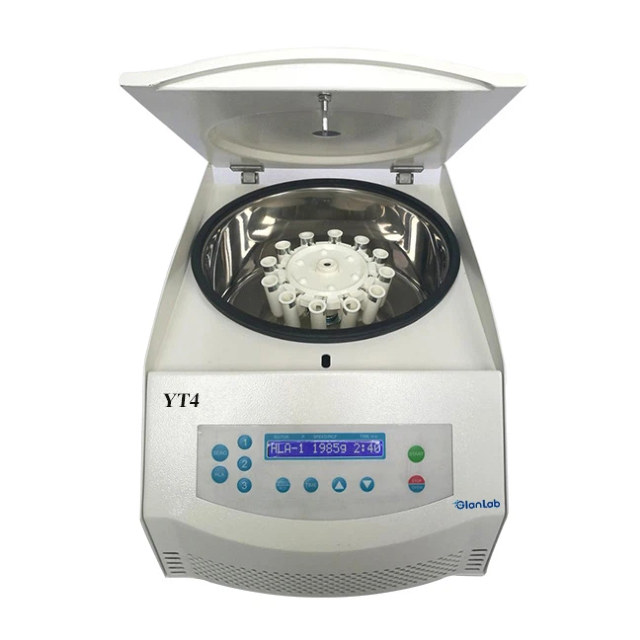
Modern centrifuges, such as those from GlanLab, often allow users to directly input RCF values rather than relying on RPM settings. This feature eliminates the need for conversions and simplifies the setup process. By entering the desired RCF, users can be confident that the correct centrifugal force will be applied during the run, optimizing the separation process and improving the overall efficiency of the experiment.
Conclusion
Understanding the difference between RPM and RCF is essential for achieving optimal centrifugation results. By using the appropriate RCF values and converting between RPM and RCF accurately, laboratories can ensure that their samples are processed with the correct centrifugal force, minimizing errors and enhancing experimental consistency.
To make this process easier, GlanLab offers an RCF ⇄ RPM calculator that can quickly provide accurate conversions and ensure that your centrifuge runs are always optimized for the best results. For more information or assistance with selecting the right centrifuge for your needs, contact us today.
FAQ
Q1: What is the relationship between RPM and RCF in centrifugation?
A1: RPM is the speed at which the rotor spins, while RCF measures the g-force acting on the sample. RCF is more important because it determines the separation efficiency.
Q2: How do I calculate the RCF for my centrifuge?
A2: Use the formula: RCF = 1.118 × 10^-5 × r × (RPM)^2, where r is the rotor radius in centimeters.
Q3: Why do I need an RCF calculator?
A3: An RCF calculator helps you quickly and accurately determine the required centrifugal force based on your centrifuge settings, reducing calculation errors.
Q4: How do I convert RPM to RCF?
A4: Use the formula: RCF = 1.118 × 10^-5 × r × (RPM)^2. You can also use an online calculator for convenience.


