Centrifuge Factory Sourcing in China If you are sourcing laboratory centrifuges from China, factory photos, production lines and quality certificates are useful — but they do not answer the most important purchasing question: can this supplier reliably produce and support the exact centrifuge configuration you intend to buy?
GlanLab has been involved in centrifuge manufacturing and supply since 2001. Its current product range covers multiple laboratory centrifuge platforms, rotor configurations, OEM/ODM projects and customized rotor requirements.
For projects that specifically require a factory-origin model, private label, custom rotor or repeat production, the most useful approach is to verify the exact model at quotation level.
What should you verify in a centrifuge factory? Verify the exact model's product responsibility, rotor configuration, speed and safety specifications, refrigerated performance where applicable, final outgoing checks, replacement-parts route and repeat-order traceability.
Follow One Centrifuge Through the Factory — Not Just the Factory Tour
A typical factory introduction starts with the building, workshop, production line and finished-product area. Those are useful signals, but serious sourcing should go one step further.
Select one centrifuge model you are genuinely considering and ask the supplier to use that product throughout the discussion.
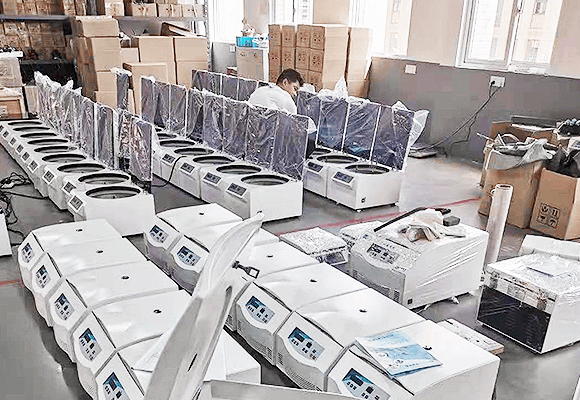
GlanLab centrifuge production / finished-product area.
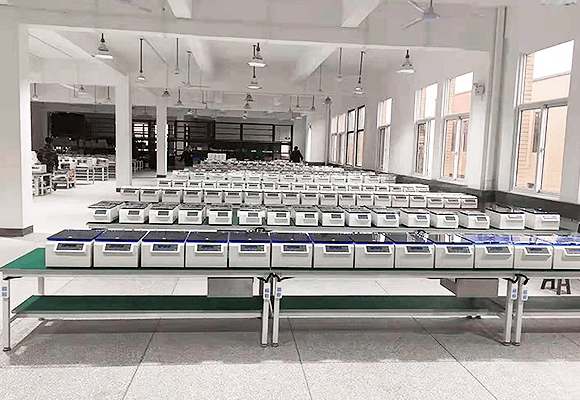
Benchtop centrifuge units shown in the current factory gallery.
A useful model-level verification path:
01 · ORIGIN Who is responsible? Confirm whether the exact model is factory-developed, OEM-sourced or supplied through another relationship.
02 · ROTOR What actually ships? Identify the rotor, adapters and usable vessel configuration.
03 · PERFORMANCE What does it really do? Confirm speed, RCF, capacity and temperature requirements.
04 · FINAL CHECK What is checked? Move beyond a generic “strict QC” statement.
05 · REPEAT SUPPLY Can you buy it again? Make sure the same configuration remains identifiable later.
“Are You a Factory?” Is Not Specific Enough
A laboratory-equipment supplier may work with different product structures: self-developed products, OEM products, partner-factory products or products represented from another brand.
That structure is not automatically good or bad. What matters is whether the origin and responsibility of your exact model are clear.
LESS USEFUL “Are you a real factory?” This gives you a company-level label, but not necessarily the source of the product on your quotation.
MORE USEFUL “Who is responsible for this exact model and configuration?” This helps clarify production responsibility, OEM feasibility, documentation and repeat supply.
GlanLab's current About page is transparent that its platform includes factory self-developed and self-sold products while also representing selected centrifuge and laboratory-product brands from China.
If your purchasing specification requires a factory-origin product, state that requirement when you request the quotation.
If you are still comparing suppliers at a broader level, see how to choose a centrifuge manufacturer in China .
For a Centrifuge, “Strict Quality Control” Needs to Become Product-Level Verification
Almost every factory claims to have strict quality control. The more useful question is:
What does the factory actually verify on the centrifuge before it is released for shipment?
SPEED CONTROL Maximum RPM Is Not the Whole Story A specification such as “5,000 rpm” tells you the headline speed. It does not describe how accurately the centrifuge controls that speed.
For example, GlanLab YT5A / YT5AR currently specify ±20 r/min speed accuracy.
For an important project, ask how speed performance is specified and what is confirmed before shipment.
ROTOR LIMIT Machine Max RPM ≠ Rotor Max RPM A centrifuge body may support a high headline speed, while a large-capacity rotor on the same platform operates at a much lower permitted RPM.
Therefore the useful specification is not only the machine model.
It is: Machine + Rotor + Adapter + Vessel.
SAFETY FUNCTIONS Confirm Protection Functions on the Exact Model Depending on the centrifuge, relevant functions may include electric lid lock, overspeed protection, imbalance protection, over-temperature protection and related alarm logic.
GlanLab YT5A / YT5AR currently list electric lid lock, overspeed and imbalance protection; the refrigerated YT5AR also lists over-temperature protection.
Ask what is included on the model being quoted, rather than asking whether the supplier has “safety protection” in general.
REFRIGERATED MODELS Temperature Range Is Only One Part of Performance Refrigerated centrifuges should also be assessed for temperature-control performance.
GlanLab YT5AR currently specifies -20°C to 40°C temperature range and ±1°C temperature accuracy.
If your samples are temperature-sensitive, ask how the exact refrigerated configuration is specified and checked.
FINAL RUN “The Motor Spins” Is Not a Complete Run Check Abnormal vibration, unusual noise, imbalance, rotor installation and alarm conditions can all matter during centrifuge operation.
Ask what the final run check covers before the machine is packed.
OUTGOING QC Ask What Makes the Product Ready to Ship Not every order requires a complex third-party inspection report.
But the supplier should be able to explain why the final centrifuge configuration is considered acceptable for shipment.
Use This Matrix to Verify the Exact Centrifuge Model
This is more useful than trying to decide whether a factory is “good” or “bad” from company-level information alone.
| Verify | Ask the Factory | Useful Result |
| Product origin | Who is responsible for this exact model? | Factory / OEM / other supply relationship is clear. |
| Machine | What exact model will be supplied? | Final model and technical specification are identified. |
| Rotor | Which rotor is included? | Rotor RPM, RCF and capacity are defined. |
| Vessel | Does this configuration fit my actual tube or bottle? | Dimensions and adapter requirements are confirmed. |
| Speed | How is speed performance specified or checked? | Speed accuracy / operating verification is understood. |
| Safety | Which protection functions are included? | Lid lock, overspeed, imbalance and other relevant functions are clear. |
| Refrigeration | How is temperature performance specified? | Temperature range and accuracy are understood. |
| Final run | What is checked before packing? | Relevant speed, vibration, noise or alarm checks are explained. |
| Repeat order | How will the same configuration be identified later? | Machine, rotor, adapter and order information remain traceable. |
| After-sales supply | How can I buy rotors or parts later? | A replacement and support route is available. |
The goal is not to find a factory that gives the fastest “yes.” The goal is to find a supplier that can give clear answers tied to the exact centrifuge configuration you intend to purchase.
Rotor Capability Is Part of Centrifuge Factory Capability
A centrifuge does not perform an application by itself.
The real working system is: Centrifuge + Rotor + Adapter + Vessel + Protocol.
The rotor determines usable vessel geometry, samples per run, maximum permitted RPM, actual RCF and whether adapters are required.
That is why a supplier showing many centrifuge bodies but unable to define rotor compatibility still leaves a major part of the application unresolved.
Where a standard rotor already fits the vessel, capacity and target RCF, the standard configuration is generally the simpler solution.
Custom rotor work becomes useful when a real application cannot be solved by the available standard rotor system.
Read the centrifuge rotor selection guide → Rotor Model Which exact rotor ships with the machine?
Max RPM What is the rotor's permitted limit?
Max RCF Does the actual rotor meet the protocol?
Capacity How many real samples per run?
Vessel Geometry Does the tube or bottle actually fit?
Adapters Are any additional components required?
For Distributors and Importers, Factory Capability Continues After the First Shipment
An end laboratory often asks: “Can this centrifuge perform my workflow?”
A distributor or importer must also ask: “Can I continue selling and supporting this product later?”
Repeat-Order Consistency The same machine, rotor, adapter and electrical configuration should remain identifiable.
Rotors & Replacement Parts The customer may need another rotor, adapter, tube or service part months or years later.
Technical Support Distributors need an upstream route for application and equipment questions they cannot solve internally.
GlanLab's current Support page lists centrifuge rotors and tubes, technical support, problem analysis, after-sales service and retention of previous order records.
These capabilities are less visible than a production line, but for repeat purchasing they can be more important.
View centrifuge technical and after-sales support →
Cannot Visit China? Make the Remote Factory Check Model-Specific
A professionally edited factory video is useful for understanding the company environment.
But if you want to verify a purchasing project, make the request more specific.
Instead of: “Please send me your factory video.”
Ask: “Please show me the production or assembly area for the exact centrifuge model I am considering.”
Show the actual model Make sure the discussion stays tied to the quoted product.
Show the matching rotor Confirm that the final working configuration is defined.
Explain the outgoing check Ask what is confirmed before the model is packed.
Show final packing scope Machine, rotor, adapters, accessories and documents should match the quote.
For repeat purchasing, ask one more question: “If I reorder this configuration next year, how will you identify the same machine, rotor and accessories?”
Quality Management Systems and Product-Level Verification Are Not the Same Thing
Factory quality-management information is important, but it should not be confused with verification of a specific centrifuge configuration.
Why this distinction matters ISO 9001 and ISO 13485 relate to quality-management systems. Laboratory centrifuges also have product-specific safety requirements.
The current IEC standard is IEC 61010-2-020:2026 — Particular requirements for laboratory centrifuges, intended for use together with IEC 61010-1.
A buyer does not need to become a standards engineer.
The practical lesson is simpler:
A company-level quality system does not automatically prove that every model, rotor combination or OEM variation has the same product-level configuration or evidence.
Return to the exact model, exact rotor and exact version being quoted for your market.
What Should Different Buyers Verify?
Laboratory Application fit, correct rotor, usability and after-sales support.
Distributor / Importer Product range, repeat supply, rotors, parts and technical support.
OEM / Private Label Product origin, customization, configuration and repeatability.
Project Buyer Sample, vessel, RCF, capacity, temperature and final delivery configuration.
Factory capability should therefore be evaluated against the project, not against factory size alone.
A large standardized factory is not automatically the best source for a small special-rotor project. Likewise, a technically flexible supplier may not be the right source for a very large standardized production program.
How to Start a Centrifuge Factory-Sourcing Enquiry With GlanLab
If you already know the centrifuge model, send the model number directly.
If you do not yet know the correct model, send as much application information as you currently have:
Application · Sample / Vessel · Vessel Dimensions · Required RCF · Capacity · Temperature Requirement · Destination Country · Voltage / Frequency · Quantity · Rotor Requirement · OEM Requirement
If your purchasing specification specifically requires a factory-origin model, state: “Factory-origin model required.”
This allows the discussion to begin with:
Product Origin → Machine → Rotor → Application → Final Configuration
Discuss Your Centrifuge Sourcing Project
You do not need a formal factory-audit document to start. Send the model or application you are evaluating, together with any rotor, OEM, factory-origin or market requirement.
Application Sample / Vessel Vessel Dimensions Required RCF Capacity Temperature Target Model Rotor Country Voltage / Frequency Quantity OEM Requirement
Discuss Your Centrifuge Project 


