When choosing the right centrifuge for your laboratory, the decision often comes down to two primary options: the floor standing centrifuge and the benchtop centrifuge. Both machines serve the same purpose—separating components of a mixture at high speeds—but they differ significantly in terms of budget, space requirements, and sample capacity. Selecting the right centrifuge is critical, not only to ensure optimal sample processing but also to improve lab efficiency.
At Glanlab, we specialize in providing a wide range of centrifuges to meet the needs of various industries, from blood banks to clinical research laboratories. Our centrifuge solutions are designed to deliver superior performance and reliability. In this article, we’ll guide you through the pros and cons of each centrifuge type, helping you identify the best option based on your laboratory's specific requirements.
I What is Floor Standing vs Benchtop Centrifuge?
1.Floor Standing Centrifuge
A floor standing centrifuge is a robust and high-performance machine designed for larger sample volumes and industrial-level use. These centrifuges are typically used in environments such as blood banks, pharmaceutical manufacturing, and large research laboratories. A great example is the YD5 Floor Universal Blood Bank Economic Centrifuge from Glanlab, which is designed to handle large quantities of blood samples at once, offering a high rotor capacity that allows for up to 4×800 mL sample processing. This high capacity ensures that the centrifuge can handle multiple samples in a single run, making it ideal for environments with high throughput demands.
2.Benchtop Centrifuge
In contrast, the benchtop centrifuge is compact and designed for smaller-scale applications. It is ideal for smaller labs, clinics, and teaching environments where space is limited. Benchtop models are suitable for routine laboratory work, such as processing small volumes of samples (typically 6 to 24 tubes). These centrifuges are also more affordable and portable, making them a popular choice for laboratories that don’t require large sample capacities. Despite their smaller size, these centrifuges still offer powerful performance and can handle various sample types in a fraction of the time compared to manual methods.
I Floor Standing vs Benchtop — Side-by-Side Comparison
Here’s a comparison to highlight the key differences:
Table1: Comparison of Floor Standing and Benchtop Centrifuges
Comparison Factor | Floor Standing Centrifuge | Benchtop Centrifuge |
Budget / Cost | Higher initial cost | Lower purchase cost |
Space Requirement | Requires dedicated floor space | Mounts on benchtop, compact |
Capacity / Throughput | High — large sample/rotor loads | Medium — 6~24 tubes |
Flexibility / Applications | Broad rotor options, high range | Standard rotors |
Ease of Use | Requires setup, installation | Simple plug-and-play |
Use Scenarios | Blood banks / high throughput labs | Small labs / teaching |
I Budget: How Cost-Effective Are They?
When it comes to budget, the floor standing centrifuge is typically more expensive, both in terms of the initial purchase price and the long-term operational costs. These machines require more floor space, specialized installation, and tend to have higher maintenance costs. However, the higher initial cost is often justified by their higher throughput, longer lifespan, and ability to handle larger volumes of samples in a single cycle. For facilities that require continuous processing or work with high-volume tasks, the investment in a floor standing centrifuge can result in significant operational efficiency.
On the other hand, benchtop centrifuges are significantly more affordable, making them an excellent choice for labs with limited budgets or those that don't need to process large sample volumes. While the initial cost is lower, it’s important to consider the maintenance costs, energy usage, and durability of the centrifuge, especially if your lab needs to perform repetitive tasks that may require more frequent maintenance.
I Space: Lab Footprint and Layout Planning
Floor standing centrifuges require a considerable amount of floor space, which makes them suitable for larger laboratories that have ample room to accommodate their size. These machines are typically installed in dedicated corners or areas of the lab to optimize available space. However, this large footprint may limit their use in smaller, more compact environments, and it’s crucial to assess whether your lab has the space for such a large machine before making a decision.
In contrast, benchtop centrifuges are designed to be space-efficient and can easily be placed on the countertop, which makes them ideal for smaller labs, teaching facilities, or clinics where space is limited. Their compact design also makes them easier to move and store when not in use, giving labs the flexibility to reconfigure their workspace as needed.
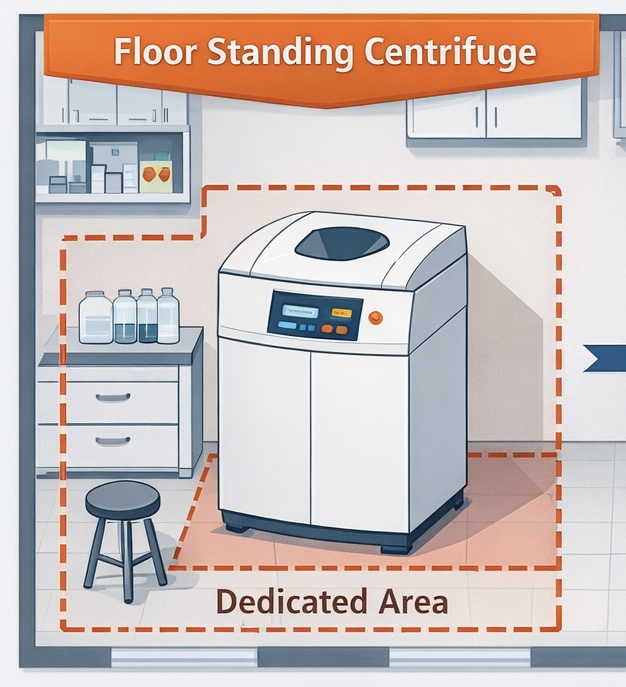
Requires Significant Floor Space

Fits on Lab Bench
I Capacity: Throughput and Performance Differences
The capacity and throughput of a centrifuge are key factors in deciding which type best suits your lab's needs. Floor standing centrifuges can process much larger volumes of samples in a single run, which makes them ideal for applications that require high throughput. For example, the YD5 Floor Universal Blood Bank Centrifuge can handle 4×800 mL of blood or other fluids at once, allowing for large batches to be processed efficiently.
Benchtop centrifuges, however, are designed for smaller sample sizes, usually ranging from 15 to 50 mL tubes. These centrifuges are ideal for labs that deal with routine tasks or small sample sets, typically processing 6 to 24 samples at a time. While they may not be able to handle the large volumes of a floor standing model, they are sufficient for most basic laboratory tasks.
Table2: Sample Capacity Comparison
Centrifuge Type | Sample Size | Capacity per Cycle |
Floor Standing | 800 mL or more | Up to 32 samples |
Benchtop | 15–50 mL | 6–24 samples |
I Use Case Scenarios: Ideal Environments for Each
Scenario A: Blood Bank Station
In a blood bank, where high throughput and large volumes of blood samples need to be processed daily, a floor standing centrifuge is the ideal solution. It allows for continuous high-volume processing without compromising on speed or performance.
Scenario B: Teaching Lab or Small Clinic
For a teaching lab or a small clinic, where space and budget are more limited, a benchtop centrifuge is a more practical choice. It provides the necessary functionality while being affordable and portable.
Scenario C: Pharmaceutical Factory
In a pharmaceutical factory, where capacity and efficiency are essential, a floor standing centrifuge ensures that large batches of samples can be processed quickly and efficiently.
I Pros & Cons Summary
Table3: Pros and Cons of Floor Standing vs Benchtop Centrifuges
Type | Pros | Cons |
Floor Standing | High throughput, flexible for different rotor types | High cost, large space requirement |
Benchtop | Compact, affordable, easy to use | Limited capacity, lower throughput |
I How to Choose the Right One for Your Lab?
Choosing between a floor standing and benchtop centrifuge depends on the specific needs of your lab. Consider the following guidelines:
High sample volume? — Choose Floor Standing.
Tight on space? — Go for Benchtop.
Limited budget? — Opt for Benchtop.
Long-term scaling required? — Floor Standing is your best choice.
Conclusion
At Glanlab, we understand the importance of selecting the right centrifuge to meet your laboratory’s needs. Both floor standing centrifuges and benchtop centrifuges have their place in laboratories depending on factors like sample volume, space, budget, and long-term goals. By considering the factors outlined in this article, you can make an informed decision that best supports your lab’s efficiency and productivity.
FAQ
Q1: Can a benchtop centrifuge replace a floor-standing centrifuge?
In most cases, a benchtop centrifuge cannot replace a floor-standing centrifuge due to the significant difference in capacity. Floor-standing models are designed for higher throughput and larger sample volumes, which benchtop models are typically not equipped to handle.
Q2: Which centrifuge is better for a small lab with limited space?
A benchtop centrifuge is the best option for a small lab with limited space. It’s compact, affordable, and easy to integrate into smaller work areas.
Q3: What’s the maintenance like for a floor-standing centrifuge?
Floor-standing centrifuges generally require more maintenance due to their larger size and complex systems. Regular servicing is recommended to ensure optimal performance, especially for rotor maintenance and cooling systems


