The first question in urinary cfDNA centrifugation is not how fast to spin. It is which DNA-containing fraction your assay needs to retain.
Routine urine sediment testing and urinary cell-free DNA (ucfDNA) workflows may use the same centrifuge platform but make different decisions about the supernatant, pellet, subsequent handling and sample-quality evidence. Those decisions determine the suitable rotor and tube configuration.
Direct answer
For many urinary cfDNA methods, the supernatant is collected after centrifugation to limit residual cellular contamination. But cfDNA or a clinically relevant target may also be associated with the pellet or cellular material in certain applications. Define the assay target and fraction first; then confirm the validated RCF, tube, rotor, volume, handling window and storage process. Neither a "urine centrifuge" label nor its maximum RPM establishes suitability.
01 · TARGETSupernatant, pellet or both?
The intended biomarker and analytical method determine what should be retained.
02 · PROCESSRemove debris without losing the target
Extra spins may change recovery and background-DNA contamination differently.
03 · CONFIGUREVerify the actual vessel and rotor
Maximum RCF and nominal tube capacity are not operating approvals for every tube.
Urinary cfDNA Is Not the Same Endpoint as Urine Sediment
Routine urine-sediment examination commonly concentrates cells and other formed elements for microscopy. A urinary cfDNA method may instead analyse extracellular DNA in cleared urine supernatant. If the sediment is discarded without first defining the analytical endpoint, potentially useful sample fractions can be lost.
However, "always keep only the supernatant" is not an appropriate universal rule. The US National Cancer Institute (NCI) notes that cfDNA of interest may be associated with a urine pellet, and that some studies detected more of a particular fetal or tumour-associated DNA signal in the pellet than in the supernatant. A pellet result must not automatically be labelled pure cell-free DNA: intact cells, debris and cell-associated nucleic acids may also be present.
Analytical objective
Fraction to consider
Practical consequence
Supernatant ucfDNA
Processed urine supernatant
Avoid cellular carryover while maintaining the required cfDNA recovery.
Cell-associated urine DNA
Cell-rich pellet
Control sediment recovery and the extraction method; do not equate this fraction with purely extracellular DNA.
Mixed or exploratory biomarker research
Supernatant and pellet, separately
Track two fractions, potentially different extraction paths and separate storage vessels.
Validated whole-urine method
Whole urine as required
Do not add a centrifugation step without evaluating its effect on the target assay.
The collection and fraction choice should therefore follow the assay's evidence and standard operating procedure (SOP), rather than a generic urine separation program.
Why a Clear Supernatant Does Not Guarantee cfDNA Quality
Centrifugation can reduce cells and particulate material, but visual clarity does not establish cfDNA integrity. Urine chemistry, nuclease activity, processing delays, preservation and freezing can change the recovered DNA.
RISK A · TARGET LOSS
Loss or degradation of the intended DNA
Some preparation or storage conditions reduce recoverable ucfDNA or alter its fragment-size profile. A cleaner-looking specimen is not necessarily a better specimen for the intended assay.
RISK B · BACKGROUND DNA
Additional genomic DNA from cells
Cells that lyse during unsuitable handling can release high-molecular-weight genomic DNA (gDNA), increasing total DNA without necessarily improving the analyte of interest.
For a low-abundance marker, more extracted total DNA can even reflect a less favourable specimen composition. Depending on the assay, evaluation may require cfDNA yield, fragment-size distribution, evidence of high-molecular-weight DNA, repeatability and downstream assay performance—not concentration alone.
What RCF Does the 2026 NCI Urine cfDNA Guidance Describe?
The NCI's Cell-Free DNA: Urine Collection and Processing, initially released on 21 October 2026, describes a reference step to separate cells from urine. It recommends transferring supernatant to a new tube and permits additional study of the pellet. A second spin may be performed to remove more cellular debris when appropriate.
Spin duration 10 minutesFor the specified NCI step
Temperature 4°C or RTAs specified by the method
These are reference conditions from that document, not mandatory operating values for every urinary cfDNA application. Other published methods use different centrifugation conditions. The laboratory should use an assay-appropriate, verified process and the instructions for its actual sample vessels.
Do not copy the plasma cfDNA workflow into urine. The sample matrix, target fractions and pre-examination evidence differ. A high-speed second spin used in one plasma protocol is not a universal requirement for urine ucfDNA.
Does a Second Spin Improve Purity or Reduce Recovery?
It can do either, depending on the sample and method. Further centrifugation may decrease residual cellular material or background gDNA, yet also reduce target cfDNA recovery. A decision based on only one of those measurements can be misleading.
A study published in PLOS ONE on 27 August 2026 evaluated centrifugation, EDTA concentration, storage and thawing strategies for ucfDNA. Most experimental comparisons used pooled urine from healthy volunteers, with a small proof-of-concept assessment involving six patients with urological tumours. The exploratory study used approximately 15 mL portions in 50 mL centrifuge tubes and, for its tested initial separation, 3,000 ×g for 15 minutes—not the NCI's 1,200–2,500 ×g example.
Under some of the study's frozen-supernatant and slow-thaw conditions, a post-thaw secondary centrifugation markedly reduced recovered ucfDNA. However, this was condition-dependent; results differed with the storage and thaw approach. It would be incorrect to infer that all second spins are harmful, or that the study's preservation formulation should become a universal laboratory SOP.
Observation
Possible benefit
What must still be checked
Lower high-molecular-weight DNA
Less unwanted background for some analyses
Was the intended ucfDNA fraction also lost?
Higher total DNA yield
More extracted nucleic acid
Did the increase come from lysed cells?
Further particle removal
Less residual cellular material
Does the downstream assay actually benefit?
Extra centrifugation after thaw
May be part of a validated cleanup
What is the effect on cfDNA yield and fragment quality under that thaw method?
The useful decision is not "one spin or two?" in isolation. It is whether the additional step improves the validated endpoint without unacceptable loss of the DNA fraction being studied.
Preservative Timing and Processing Delay Cannot Be Separated from Rotor Planning
The NCI procedure describes processing unpreserved urine at room temperature as soon as feasible, optimally within about one hour, while recognising that suitable preservatives may support different handling windows. Its guidance also discusses collecting urine with a preservation strategy when prompt processing is not possible.
The 2026 PLOS ONE study examined EDTA treatment of whole urine and of separated supernatant and found different outcomes in its studied conditions. This does not establish a universal preferred concentration or addition point for all projects: specimen type, assay, time and storage conditions matter.
For procurement, the central question is whether the available centrifuge configuration can process peak arrivals within the validated collection-to-processing window. A machine with an impressive maximum speed may still create a sample queue if too few approved positions are available for the real specimen volume.
Collection Volume, Aliquot Volume and Tube Capacity Are Three Different Numbers
A study collecting 100 mL of urine does not necessarily centrifuge that urine in a single 100 mL tube. The 2026 experimental study collected individual volumes of roughly 50–250 mL but used approximately 15 mL aliquots in 50 mL tubes during its controlled experiments. Collection volume, actual fill volume and nominal vessel capacity must therefore be kept distinct.
Required vessels per specimen = ceiling(specimen volume ÷ approved usable fill volume per vessel)
Illustrative workload, not a product test: A lab has 12 specimens of 60 mL each. Suppose its specific method and approved tubes allow 40 mL per nominal 50 mL vessel. Each specimen needs 2 vessels, so the batch contains 24 vessels. A 6-position rotor needs at least 4 fully occupied runs; a 4-position rotor needs at least 6. Actual runs also depend on the permissible balance pattern, available adapters, loading, acceleration/deceleration and handling time. The assumed 40 mL fill is not a universal tube rating.
If an assay needs both supernatant and pellet, include the additional transfer, identification and storage containers in throughput planning. The number of original specimens alone may understate how many tubes the total workflow uses.
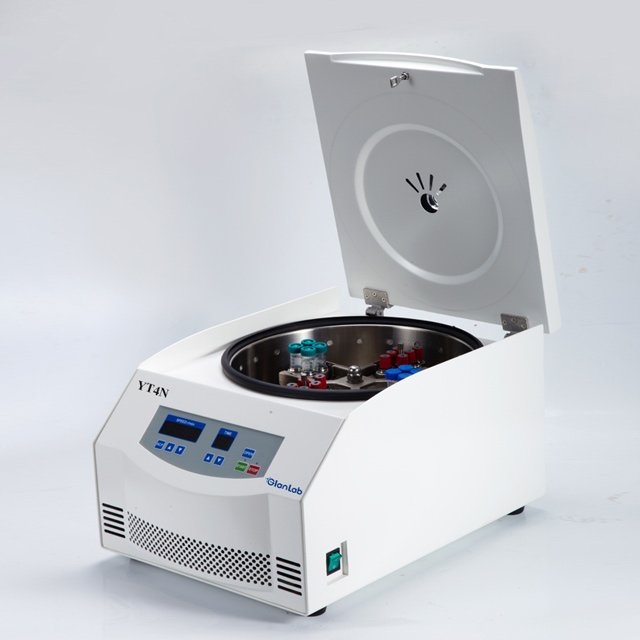
GlanLab publishes a YT4N main-unit maximum of 5,000 rpm and 3,460 ×g. That top-level number does not apply to every available rotor. The listed rotor options provide different maximum forces and capacities.
YT4N rotor
Published nominal configuration
Published maximum RCF
At a method requiring 2,500 ×g
5K-3
18 × 15/10 mL
2,250 ×g
Below the specified force: not eligible for that exact requirement.
5K-9
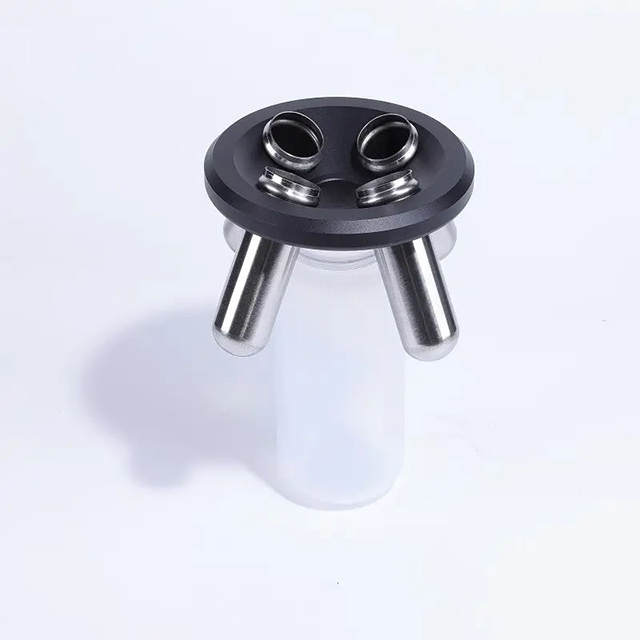
4 × 50 mL
2,520 ×g
Nominally reaches 2,500 ×g; only 20 ×g above the target.
5K-10
6 × 50 mL
2,850 ×g
Published rotor ceiling exceeds the target; vessel verification still required.
5K-11
4 × 100 mL
2,630 ×g
Published ceiling exceeds the target; larger nominal volume is not usable fill.
5K-12
6 × 100 mL
3,130 ×g
Published ceiling exceeds the target; verify the actual 100 mL vessel.
The 5K-9 illustrates a specific specification risk: its published upper limit is 2,520 ×g, just 20 ×g (0.8%) above a hypothetical 2,500 ×g requirement. That is not proof that it fails or is unsafe; it is a reason to verify the method's specified RCF, the applicable radius, selectable instrument settings and performance against the requirement instead of rounding the rotor specification to "about 2,500 ×g".
For a method requiring less than 2,500 ×g, a rotor with a lower maximum RCF may still be suitable. The relevant question is compliance with the exact method, not whether the rotor has the highest advertised force.
GlanLab YT4N Low-speed platform; published main-unit maximum 3,460 ×g. Actual suitability depends on the rotor and tube.
5K-9 · 4 × 50 mL Published maximum 2,520 ×g. Tube type, dimensions and allowed operating force must be confirmed.
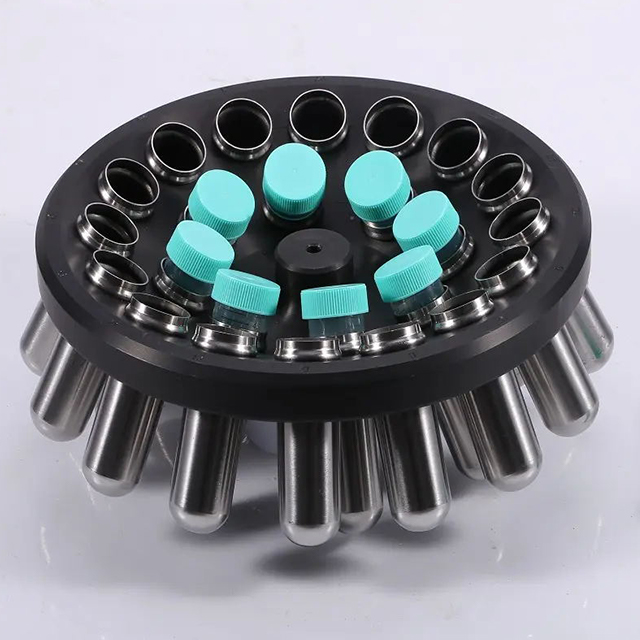
5A-15 · 24 × 50 mL Published maximum 2,970 ×g; a higher-position option for appropriately verified workflows.
The YT4N product and matched-rotor table provides a starting point for matching the real tube, target RCF and workload. It is not a ucfDNA method validation report.
When Should a Laboratory Consider YT5A or Refrigerated YT5AR?
For larger workloads, GlanLab lists higher-position rotor options on the YT5A and YT5AR platforms. Published fixed-angle options include the 5A-13 (6 × 50 mL, 2,850 ×g), 5A-15 (24 × 50 mL, 2,970 ×g), 5A-17 (6 × 100 mL, 3,130 ×g) and 5A-18 (12 × 100 mL, 2,970 ×g).
A 24-position 50 mL rotor can reduce the number of runs when a lab is processing many separately identified aliquots. A 100 mL configuration may reduce splitting for certain larger specimens. But neither advantage applies until the exact vessel dimensions, cap clearance, usable fill and approved operating force are checked.
Refrigeration is also method-dependent. The NCI reference procedure allows 4°C or room-temperature centrifugation; it does not make refrigeration compulsory for every urinary cfDNA assay. If the SOP specifies controlled low temperature, a suitable refrigerated configuration such as the GlanLab YT5AR may be considered, with verification of actual sample-temperature performance and compatible rotors. If the validated procedure permits ambient processing, refrigeration should not be presented as automatically producing better cfDNA.
How to Specify a Urinary cfDNA Centrifuge for Purchase
For laboratory buyers, procurement teams and distributors, a useful quotation request starts with the sample and assay instead of a generic "urine centrifuge" category.
Information to provide
What it determines
Analytical endpoint
Supernatant cfDNA, pellet-associated DNA, whole urine, or both fractions separately.
Sample volume per specimen
Original collection volume and the actual volume to be loaded per vessel.
Vessel identity
Exact tube brand/type and dimensions, lid, material, maximum permitted RCF and approved fill.
Method-defined conditions
RCF, duration, temperature, and any required acceleration or braking condition.
Workload and arrival pattern
Peak specimens, aliquots, allowed waiting time, and expected runs per processing window.
Preservation and downstream steps
When stabiliser is added, when supernatant is transferred, and extraction/freezing requirements.
Purchase and installation details
Destination country, voltage/frequency, ordered rotors, adapters, documentation and support requirements.
The complete setup must respect the applicable limits of the centrifuge, rotor, adapter and vessel. A rotor described as "6 × 100 mL" does not certify that every nominal 100 mL tube can safely hold 100 mL at its rated maximum force.
What Results Show That the Processing Method Works?
Neither a visibly clear supernatant nor a larger total DNA number is sufficient. Depending on the assay, laboratory quality checks can include cfDNA recovery, fragment-size distribution, high-molecular-weight DNA contamination, repeatability and downstream target detection. The NCI recommends size-aware cfDNA quantification, such as capillary electrophoresis or qPCR using different amplicon sizes, while recognising appropriate alternatives in defined circumstances.
The most effective equipment configuration is therefore the one that supports an accepted method, protects the intended analyte and meets the real collection-to-processing window—not necessarily the largest or fastest centrifuge.
Frequently Asked Questions
Should urinary cfDNA analysis always use the supernatant?
No. Supernatant is a common target for extracellular DNA analysis, but some targets are also associated with the pellet or cells. The assay should determine whether the supernatant, pellet, whole urine or separately collected fractions are required.
What centrifugation force is used for urine cfDNA preparation?
The 2026 NCI reference procedure describes 1,200–2,500 ×g for 10 minutes at 4°C or room temperature to separate cells. It is not a universal operating prescription; use the conditions validated for the actual specimen and test.
Is a second urine centrifugation step mandatory?
No. The NCI describes it as optional. Further clearing may reduce debris or background DNA in some methods, but it may also change cfDNA recovery. The decision requires method-specific evidence.
Does more total DNA mean that preservation was better?
Not necessarily. DNA released from lysed cells can raise total yield while increasing high-molecular-weight background DNA. Fragment profiles and downstream assay quality should also be evaluated.
Must a 100 mL specimen be processed in a 100 mL tube?
No. A validated workflow may permit aliquoting into smaller approved vessels. The number of tubes depends on actual usable fill volume, not only collection volume or nominal tube capacity.
Can the GlanLab YT4N perform a method requiring 2,500 ×g?
It depends on the rotor. The published 5K-3 maximum is 2,250 ×g, while 5K-9, 5K-10, 5K-11 and 5K-12 have published maxima above 2,500 ×g. Exact tube compatibility and actual operating conditions must still be confirmed.
Does urinary cfDNA processing always require a refrigerated centrifuge?
No. The NCI reference procedure allows room-temperature or 4°C centrifugation. Refrigeration should be selected when required by the actual validated method and sample-handling conditions.
The Right Centrifuge Starts With the Fraction You Need
Urinary cfDNA preparation cannot be reduced to a generic urine-sediment spin or a single headline RPM. Fraction selection, cell-related contamination, target-DNA recovery, preservation timing, vessel compatibility and real batch capacity all affect the workflow.
Define the assay → retain the correct fraction → confirm method RCF and temperature → verify the actual tube and rotor → calculate the required batches → check downstream cfDNA quality.
GlanLab's YT4N, YT5A and YT5AR platforms provide different rotor capacities and temperature-control options. A suitable configuration should be chosen from the validated sample-processing requirements, not from nominal tube size or maximum speed alone.
Technical References
International Organization for Standardization. ISO 18704:2026. Molecular in vitro diagnostic examinations — Requirements and recommendations for pre-examination processes for urine and other body fluids — Isolated cell-free DNA. Published February 2026.
US National Cancer Institute.Cell-Free DNA: Urine Collection and Processing. Biospecimen Evidence-Based Practices. Initial release: 21 October 2026.
PLOS ONE. Li W. et al. Impact of preanalytical variables on urinary cell-free DNA quality: Centrifugation, EDTA concentration, storage and thawing strategies. 27 August 2026; 21(8): e0356722.
GlanLab. YT4N Low Speed Urine Sediment Separation Centrifuge; YT5A Desktop Low Speed Centrifuge; YT5AR Blood Station Refrigerated Centrifuge — published product and matched-rotor specifications.
Method-specific specimen instructions, approved vessel specifications and applicable laboratory quality requirements remain controlling for actual sample processing.
Need a Centrifuge Configuration for Urinary cfDNA Processing?
Share your required specimen fraction, tube specifications, RCF, temperature, sample volume and peak batch count. GlanLab can help assess appropriate centrifuge and rotor configurations.
GlanLab, with over 20 years of experience, manufactures a full range of centrifuge machines, including benchtop, high-speed, floor-standing, and specialized models in China. We offer distribution, wholesale, OEM services, and single-unit orders at competitive prices. With complete quality certifications and robust after-sales support, GlanLab is your trusted partner for centrifuge supplies.